| Arthur Koestler 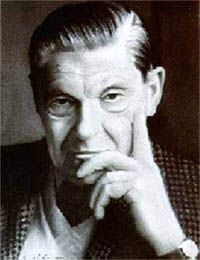 AKA Arthur Köstler AKA Arthur Köstler
Born: 3-Sep-1905
Birthplace: Budapest, Hungary
Died: 3-Mar-1983
Location of death: London, England
Cause of death: Suicide
Gender: Male
Religion: Atheist
Race or Ethnicity: White
Sexual orientation: Straight
Occupation: Author, Journalist, Philosopher Nationality: Hungary
Executive summary: Darkness at Noon Military service: British Pioneer Corps (1941-42) Hungarian-born writer-philosopher who focused on the disparity between reason and emotion and fought the encroachment of totalitarianism in the wake of the revolutions of the early 20th century. During the Spanish Civil War, Koestler was taken prisoner and interned at a prison in Malaga. Koestler spent 100 days under a death sentence before his release, capturing the experience in the memoir Dialogue with Death (1942) and the novel Darkness At Noon (1940).
In his book The Thirteenth Tribe, Koestler argues that the majority of European Jewry is actually descended from the Khazars, a Turkish power that existed in present-day Ukraine that in AD 740 converted to Judaism, eventually migrating westward to present-day Poland and Lithuania.
In 1980, Koestler became one of the vice presidents of the Voluntary Euthanasia Society, EXIT. Suffering from Parkinson's disease and terminal leukemia, Koestler committed suicide via barbiturate overdose, accompanied by his perfectly healthy third wife. Father: Henrik K. Koestler
Mother: Adele Jeiteles
Wife: Dorothy Asher (m. 1935, div. 1950)
Wife: Mamaine Paget (his secretary; m. 1950, div. 1952)
Wife: Cynthia Jefferies Patterson (his secretary; b. 1927, m. 1965, d. 3-Mar-1983, suicide pact with her husband)
Slept with: Simone de Beauvoir
Slept with: Jill Craigie (filmmaker, wife of Michael Foot, c. 1953, later accused him of rape)
University: Technische Hochschule Vienna (1922-6, dropped out)
Sonning Prize 1968
Commander of the British Empire 1972
Communist Party Germany (1931-38)
Traveled to the USSR
Held Prisoner Seville, Spain (Feb-1937 to Jun-1937)
Released in Prisoner Exchange Spain
Naturalized UK Citizen 1945
Converted to Atheism from Judaism (1949-50)
Tonsillectomy
Suicide Attempt
Hunger Strike
Drug Overdose
Allied Internment Camp Inmate
Escaped Death Sentence
Hungarian Ancestry
Jewish Ancestry
Risk Factors: Parkinson's, Leukemia, LSD, Bipolar Disorder
Author of books:
Spanish Testament (1937, memoir)
The Gladiators (1939, novel)
Darkness at Noon (1940, novel)
The Scum of the Earth (1941, novel, written in English)
Dialogue with Death (1942, memoir, abridgement of Spanish Testament)
Arrival and Departure (1943, novel)
Twilight Bar (1945, novel)
The Yogi and the Commissar (1945, essays)
Thieves in the Night (1946, novel)
The Challenge of Our Time (1948, anthology of essays, by Koestler, E. M. Forster, et al.)
Insight and Outlook: An Inquiry into the Common Foundations of Science, Art and Social Ethics (1949, nonfiction)
Promise and Fulfillment: Palestine 1917-1949 (1949, nonfiction)
The God that Failed (1950, nonfiction, ed. R.H.S. Crossman)
The Age of Longing (1951)
Arrow in the Blue (1952, autobiography, volume 1)
The Invisible Writing (1954, autobiography, volume 2)
Trail of the Dinosaur (1955, essays)
Reflections on Hanging (1956)
The Sleepwalkers: A History of Man's Changing Vision of the Universe (1959)
The Watershed (1960, abridgement of The Sleepwalkers)
The Lotus and the Robot (1960)
Control of the Mind (1961)
Hanged by the Neck: An Exposure of Capital Punishment (1961, nonfiction, with C.H. Rolph)
Suicide of a Nation? An Inquiry into the State of Britain Today (1963, nonfiction)
The Act of Creation (1964, nonfiction)
Studies in Psychology (1965, nonfiction)
The Ghost in the Machine (1967, nonfiction)
Drinkers of Infinity: Essays 1955-1967 (1968, essays)
Beyond Reductionism: New Perspectives in the Life Sciences (1969, essays, ed. with J.R. Smythies)
The Case of the Midwife Toad (1971, about Paul Kammerer)
The Roots of Coincidence (1972, nonfiction)
The Call-Girls (1972, novel)
The Lion and the Ostrich (1973)
The Challenge of Chance (1973, nonfiction, with Sir Alister Hardy and Robert Harvie)
The Heel of Achilles: Essays 1968-1974 (1974, essays)
The Thirteenth Tribe: The Khazar Empire and Its Heritage (1976, nonfiction)
Life After Death (1976)
Janus: A Summing Up (1978)
Bricks to Babel: Selected Writings With Comments by the Author (1980)
Stranger in the Square (1980, autobiography, volume 3, written with his wife, Cynthia Jefferies Patterson)
Requires Flash 7+ and Javascript.
Do you know something we don't?
Submit a correction or make a comment about this profile
Copyright ©2019 Soylent Communications
|


