|
Soylent Green (19-Apr-1973)
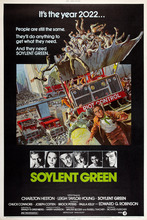
Director: Richard Fleischer Writer: Stanley R. Greenberg From novel: Make Room! Make Room! by Harry Harrison Original Music: Fred Myrow Producers: Walter Seltzer; Russell Thacher Keywords: Sci-Fi, Dystopian, Cannibalism, New York Earth in 2022 is overpopulated, ruled by elites, heavily rationed and riot-prone; the general population is fed largely by colored protein wafers of the Soylent Corporation. Charlton Heston is Det. Thorn, New York Police detective called in to investigate the death a one of Soylent's directors, presumably at the hands of a burglar. Thorn's friend Sol Roth is old enough to remember the past, before society had taken its ugly turn. Edward G. Robinson's last film. Winner of the Nebula Award for Best Dramatic Presentation.
[watch trailer]
CAST | Starring | | Charlton Heston | ... Thorn | | Leigh Taylor-Young | ... Shirl | | | Co-Starring | | Chuck Connors | ... Tab Fielding | | Joseph Cotten | ... Simonson | | Brock Peters | ... Hatcher | | Paula Kelly | ... Martha | | | and | | Edward G. Robinson | ... Sol Roth | | | Co-Starring | | Stephen Young | ... Gilbert | | Mike Henry | ... Kulozik | | Lincoln Kilpatrick | ... The Priest | | Roy Jenson | ... Donovan | | | Featuring | | Leonard Stone | ... Charles | | Whit Bissell | ... Santini | | Celia Lovsky | ... The Exchange Leader | | | Additional Characters | | Dick Van Patten | ... Usher #1 | | Morgan Farley | ... Book #1 | | John Barclay | ... Book #2 | | Belle Mitchell | ... Book #3 | | Cyril Delevanti | ... Book #4 | | Forrest Wood | ... Attendant | | Faith Quabius | ... Attendant | | Jane Dulo | ... Mrs. Santini | | Tim Herbert | ... Brady | | John Dennis | ... Wagner | | Jan Bradley | ... Bandana Woman | | Carlos Romero | ... New Tenant | | Pat Houtchens | ... Fat Guard | | | And the Furniture Girls | | Joyce Williams | ... Furniture Girl | | Erica Hagen | ... Furniture Girl | | Beverly Gill | ... Furniture Girl | | Suesie Eejima | ... Furniture Girl | | Cheri Howell | ... Furniture Girl | | Kathy Silva | ... Furniture Girl | | Jennifer King | ... Furniture Girl | | Marion Charles | ... Furniture Girl |
REVIEWS Review by Dvarpala (posted on 9-Jan-2008) A stark depiction of a not-too-distant future, where society is on the point of collapse as the Earth's resources are essentially exhausted - due to pollution and over-use.
Set in New York, the majority of the population are starving and desperate for state food hand-outs, one of which is "Soylent Green".
Charlton Heston plays a police officer helping, among other things, to control the inevitable food riots that ensue whenever ther is a distribution of food.
His involvment in a murder case leads him to the horrible nature of "Soylent Green", which is basically recycled human corpses.
Very much of it's time (1973), this is topical viewing in today's ecological aware world.
Review by Don (posted on 25-May-2009) To give this movie a rating is sort of academic. As entertainment, I recall good acting by great stars holding together a somewhat lacking plot. But then, during that era we had our share of pessimistic, eco-disaster, post-nuclear, or in this case overpopulated world movies that this one fit right into.
However, embedded in this movie is one scene particularly memorable to those baby boomers of us now faced with elder care, and the difficult decisions regarding end-of-life decisions. While modern medical science in the real world has worked overtime to come up with new medicines, procedures and equipment to prolong life, in the Soylent Green world it is the opposite. Euthenasia is encouraged. It serves as a grisly source for the food of the masses, as well as a solution to the world's burgeoning overpopulation. Edward G. Robinson, when it is his time to die, is made comfortable, surrounded with big TV screens and pleasant pictures. Nice music is playing in the background. I can't recall if he is permitted a last dinner (the movie has a scene about eating contraband beefsteak instead of Soylent Green, maybe I'm getting that confused.)
Anyway, for a third time in my life I'm helping an 80+ year old aging parent make it through her last years. The scene is not as restful and comfortable as Edward G. Robinson's passing in the movie. Perhaps there is a lesson here from the movie's producers and directors that we have missed. Maybe Jack Kavorkian wasn't all wrong.
Oh, and one last note. When Robinson passed away in real life, I was told he had his extensive collection of fine artwork paraded into his room and displayed at the foot of his hospital bed, so that he could enjoy looking at them one last time. I wonder where he got the idea to do that?--don
Do you know something we don't?
Submit a correction or make a comment about this profile
Copyright ©2019 Soylent Communications
|



